Policy adherence
In-car assistants must follow domain policies even when compliance conflicts with completing the user request.
A Self-Evolving Skill Bank for Consistent, Limit-Aware LLM Agents
On the official hidden-set evaluation, TRACE (Trajectory-Contrastive Evolution; team Darwin Agent) ranks 1st overall in Track 1 (Open Track), where any LLM from any provider is permitted. TRACE leads on strict reliability, consistency, and latency while keeping cost competitive. The top entries are summarized below.
| Rank | Team | LLM used | Pass^3 ↓ | Pass@3 | Pass@1 | Successful trials | Consistency | Latency | Tokens / trial | Cost / trial |
|---|---|---|---|---|---|---|---|---|---|---|
| 1 | Darwin Agent | GPT-5.6 Sol | 70.00% | 83.33% | 70.00% | 69/90 | 88.00% | 25.87 s | 141,684 | $0.27 |
| 2 | Thylinao | Gemini 3.5 Flash | 66.67% | 86.67% | 70.00% | 67/90 | 78.85% | 52.85 s | 263,939 | $0.24 |
| 3 | Xzlon | Gemini 3.5 Flash | 63.33% | 80.00% | 80.00% | 66/90 | 87.50% | 41.00 s | 216,642 | $0.18 |
| 4–6 | 10cars | Claude Opus 4.6 | 60.00% | 80.00% | 76.67% | 65/90 | 85.42% | 104.78 s | 294,281 | $0.56 |
| — | Organizer Baseline | GPT-5.6 Sol | 50.00% | 66.67% | 60.00% | 54/90 | 85.00% | 21.21 s | 82,179 | $0.17 |
Pass^3 requires a task to be solved in all three repeated trials and measures reliability (consistency across runs); Pass@3 requires it to be solved in at least one of the three and measures potential (best-case capability). Bold highlights the best result among the four competing teams.
CAR-bench tests agents in the safety-critical reality of in-car assistants, where a user may issue incomplete, ambiguous, or unsatisfiable requests, and the agent must respond through multi-turn dialogue, tool use, and strict policy adherence. The benchmark targets two properties: consistency, producing stable behavior across repeated trials, and limit-awareness, recognizing when a request cannot, or cannot yet, be safely fulfilled instead of claiming unsupported success. Even frontier models show a substantial gap between what they can solve at least once and what they solve on every trial. TRACE is built to close that gap.
In-car assistants must follow domain policies even when compliance conflicts with completing the user request.
Agents should recognize missing tools, parameters, results, or unsafe conditions instead of claiming unsupported success.
Agents should resolve ambiguity internally where possible and ask the user for clarification only when a request remains genuinely underspecified.
Agents should behave stably across repeated trials rather than succeed once and fail on the next run.
| Model | Provider | Base | Hallucination | Disambiguation | Average |
|---|---|---|---|---|---|
| Claude Opus 4.6 | Anthropic | 80 | 48 | 46 | 58 |
| GPT-5 | OpenAI | 66 | 60 | 36 | 54 |
| Gemini 2.5 Pro | 53 | 34 | 28 | 38 |
|
| Qwen3-32B | Alibaba | 45 | 27 | 22 | 31 |
| xLAM-2-32B | Salesforce | 26 | 11 | 12 | 16 |
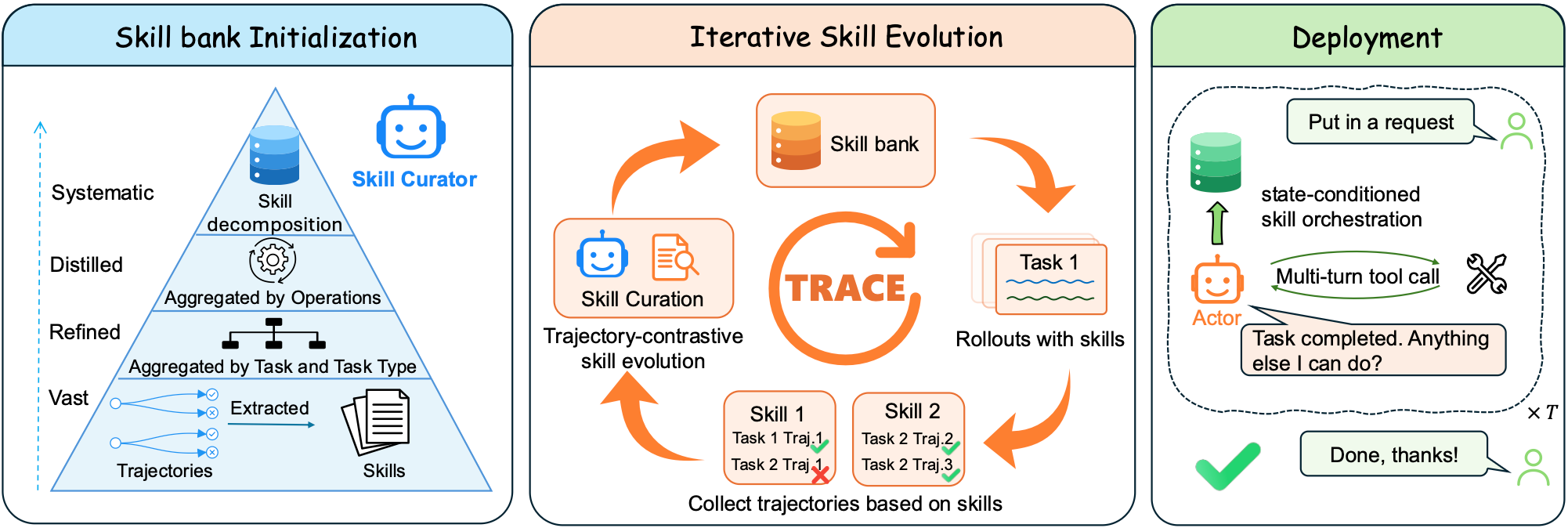
Overview of TRACE: the evolution loop refines the Skill Bank; the deployed Actor performs state-conditioned skill orchestration at every turn.
Rather than modifying model weights, TRACE improves the behavioral knowledge that an agent acts on. It couples an evolution loop — where the Curator bootstraps and iteratively refines a Skill Bank from the Actor's evaluation trajectories — with lightweight per-turn state-conditioned skill orchestration at deployment, where the Actor activates only the relevant skills to guide each turn.
A bottom-up pipeline abstracts task-specific experience into reusable, precisely retrievable competencies, \(\mathcal{B}^{\text{task}} \to \mathcal{B}^{\text{type}} \to \mathcal{B}^{\text{op}} \to \mathcal{B}^{(0)}\):
Each round applies one update \(\mathcal{B}^{(r+1)} = \Phi(\mathcal{B}^{(r)}, \mathcal{T}^{(r)})\) in three steps, corresponding to the four steps below:
Orchestration goes beyond static retrieval: conditioned on the current dialogue state, the Actor jointly determines which skills are relevant, how many to activate, and in what order to compose them, then grounds the sequence in context and recomputes it after every turn.
If this technical report is useful for your research, please cite TRACE.
@techreport{wu2026trace,
  title       = {TRACE: A Self-Evolving Skill Bank for Consistent, Limit-Aware LLM Agents: A Technical Report on the CAR-bench Challenge},
  author      = {Wenhao Wu and Menghao Zhang and Xin Wang and Zhi Wang and Kun Shao and Jian Luan},
  institution = {Xiaomi Inc. and Nanjing University and Beijing University of Posts and Telecommunications and Tsinghua University},
  year        = {2026}
}